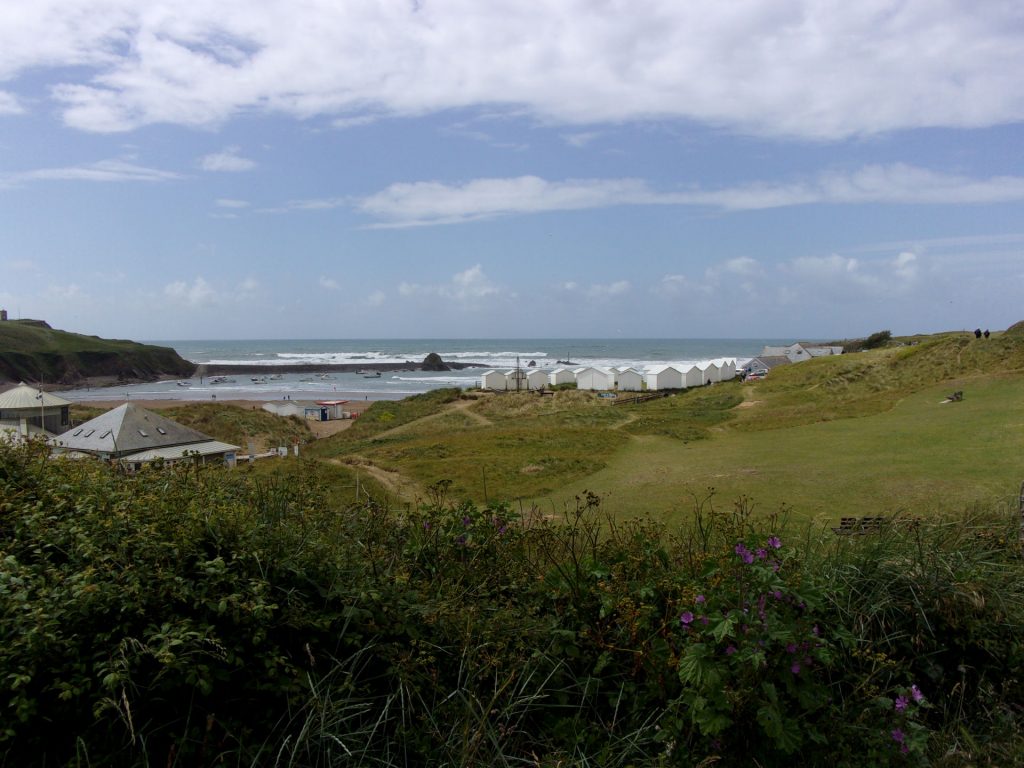
We have to leave early, before nine o’ clock on a Saturday morning, passing first of all the St Thomas train station through the sleeping suburb, we take the Dunsford road out of town and rise up and away from the city below us. The backpackers get on our bus in twos along the way. We reach Little St John’s Cross Hill and there is the end of our city. We take the road to Tedburn St Mary which is the back route and goes through Holcombe Burnell at the top of the hill as we leave Exeter behind us nestling in the Exe valley. There are pick ups at the Pathfinder Village. At Cheriton Bishop there is a sign for a display of Embroidery in the Village Hall. The bus pushes on and we pass the turning to Castle Drogo (the last castle to be built in England). Uphill we run through the village of Crockernwell, all white cottages adorned with roses growing abundantly up the old walls.
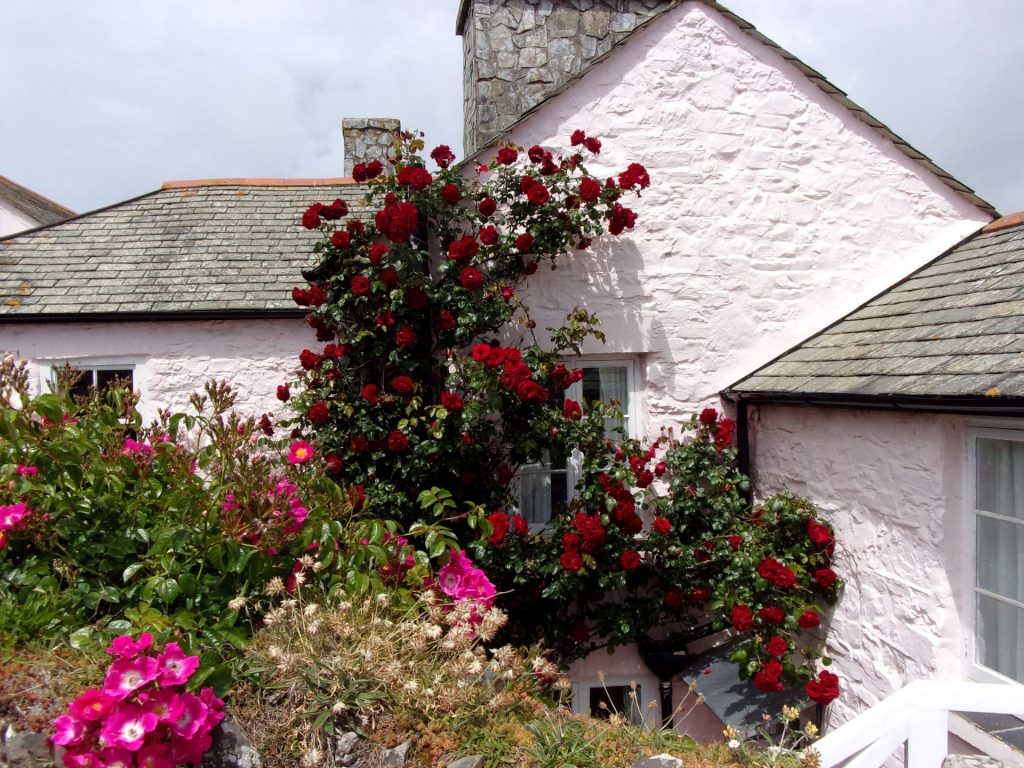
Crockernwell, quite by accident, made it into the history books because it is one the stops on the Napoleonic way. Here Lieutenant Lapenotiere from HMS Pickle changed horses. He was on his way to bring the news to Whitehall that England had beaten the combined forces of the French and Spanish navies at the battle of Trafalgar. The threat of invasion for England was finally over.
We push on to discover Okehampton, sitting in the rain shadow of Dartmoor. There it does indeed rain, there is a beautiful fast flowing river through the centre of town, sunlit and running over large granite boulders as do all Dartmoor rivers and streams. Here we pass another castle, a medieval one this time, that stands on the outskirts of Okehampton on an easily defended site with steep hillside to climb to its towering walls.
On the other side of Okehampton we begin to see and feel Dartmoor proper. There are beech lined roads, of brightest green and leafy shade. We are at Thorndon Cross, and someone flies the Devon flag, green with white cross. We are high above Devon now, riding its back. There are the forests, the windmills and the wildflower meadows. There is one that is speckled with pink flowers, then another a delicate yellow. We gradually come upon a windmill giant, white next to the road and rising high to the sky. We have to crane our necks to see its top from our double decker bus.
Then there is nothing but trees and fields until we reach Holsworthy, restful and quiet. The bus stops, a rest for all of us and the driver. We gaze at the huge jubilee flags outside the church that sits beside the small main street of Holsworthy. There is a shop here that has more washing machines on the pavement than I have ever seen.
Beyond Holsworthy you begin to sense the sea in the distance. It is after all the Atlantic, and there is nothing but sea for the next three thousand miles. Before we reach it, there is Red Post, a campsite, a filling station, even the pub has a red sign. The the sea, the sea, the moment when you finally on that journey can see the sea. My father always would shout, ‘The sea, the sea!’ which I think is the appropriate way to greet it. (Especially if you live far inland away from its airs, most of the year).
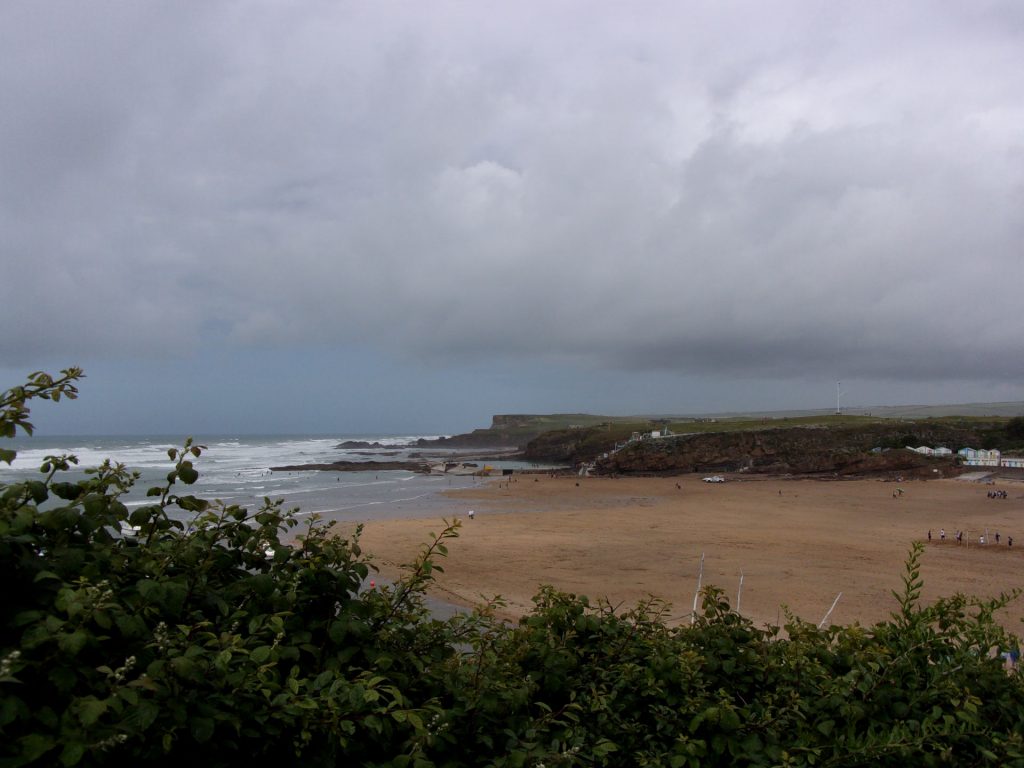
We get to Stratton which is really a large village that runs up to the outskirts of Bude and has the Kings Arms in the main street. Here the sun always shines and I wrote about a cat that watched the day pass…
We join the A3072 which in one direction takes us directly into Bude and in the opposite direction would lead us to Bideford. Up here it is a different world, unchanged since my childhood for the most part. It is far away and high up. Sea pinks everywhere wave in the sun in their favourite air.